| << Profile 14 >> |
FQA/PJA/XMA Cartic-4 car carriers |


| Build Details: |
1964-1972 BR Ashford/Rootes Pressings/Standard Wagon |
| Numbering: |
See text |
| Bogies / Suspension: |
Ridemaster |
| Dimensions: |
Set length: 200ft 2in |
| Published Drawings: |
Skinley, Barrowmore MRG |
| Areas of operation: |
Various areas |
| Main liveries: |
Blue or orange |
| Summary: |
The tricky problem of efficiently carrying motor cars within the restrictive British loading gauge was definitively solved with the introduction of this revolutionary design in 1964. Made up of sets of four, double-decked wagons articulated across five small-wheeled bogies, the Cartics were not a huge success on Motorail services but came to dominate the transportation of new cars for the next 25 years. |
|
| History: |
When it appeared, the Cartic-4 was a revolutionary solution to the problem of transporting cars by train. Simple flat wagons, both 4-wheeled and bogied, had been used for this traffic before, and there had been experiments with double-deck vehicles. These however were cumbersome and slow to load and unload. The Cartic-4 was a set of 4 wagons, semi-permanently coupled, with two decks that dipped between the bogies to provide adequate clearance within the loading gauge. Most importantly, they could be loaded by simply driving the vehicles on, flaps across the gaps between wagons enabling cars to pass over them. The only requirement was for a high-level loading ramp in addition to the normal platform height one.
Due to the relatively lightweight nature of the loads, the wagons were articulated, each set being mounted on 5 small-wheeled Ridemaster bogies similar to those fitted to early Freightliner flats. As built, the wagons had posts and chain-link railings along the upper deck to make it safer for staff to walk to and from loaded cars. Each set was just over 200ft long and capable of carrying up to 30 cars, although 28 was more normal. Taller cars could be loaded in the centre of the upper deck on each.
The prototype Cartic-4 set was built under two wagon lots at BR Ashford in 1964 and the individual vehicles were numbered B909300/1 (inner wagons) and B909400/1 (outers). Initially used for new car traffic from Ford, it was transferred by 1966 to Motorail services. A further 8 similar sets were built by Rootes in 1966/1967 but these were classified as coaching stock and numbered M95001-M95016 (outers) and M95051-M95066 (inners). The livery of this batch was the newly introduced Rail Blue, which was coincidentally very similar to the Ford blue carried by the prototype. The use of Cartic-4s on Motorail services ceased in 1978 and all the sets returned to freight use conveying new cars. The batch built for Motorail were renumbered in the air-braked series as 995001-995016 and 995051-995066, while the prototype set was tacked on the end as 995017/8 and 995067/8. The TOPS code of XMA was applied, with XMA-A for the outer wagons, XMA-B for inner wagons with brake cylinders and XMA-C for those without. The codes were changed to FQA (probably with the same AARKNDs) in 1983, and the livery remained blue. All were condemned in 1988, although two sets were reinstated for a couple of months.
Starting in 1966, a large number of Cartic-4 sets were built for private owners, these being intended purely for carrying new cars. Distribution company Silcock & Colling bought 31 orange-painted sets (124 wagons), MAT Transauto took 100 blue sets (400 wagons) and the Toleman group leased 18 (72 wagons ) from Procor that were also blue. All of these were very similar to the BR-built sets and the construction was shared between Rootes Pressings, Standard Wagon and BREL Ashford, the last set being delivered in 1972. Under TOPS these were coded as PJA or PJB, the MAT sets having vacuum pipes (later removed). The outer wagons were all PJA-A or PJB-A, while the inners were PJA-B/PJB-B and PJA-C/PJB-C.
Build and numbering details are as below
| MAT90000-90091 |
Rootes Pressings 1966-1967 |
Set numbers 401-423 |
| MAT90092-90159 |
Standard Wagon 1970 |
Set numbers 427-443 |
| MAT90160-90399 |
BREL Ashford 1971-1972 |
Set numbers 444-503 |
| SILC90420-90543 |
Rootes Pressings 1966-1967 |
Set numbers 0001-0031 |
| PR90800-90871 |
Standard Wagon 1969-1972 |
Set numbers T/01-T/18 |
Sets were formed of four consecutively numbered wagons and each wagon was also referred to by its set number and position. For example, MAT90000 was also known as 401A, MAT90001 as 401B, MAT90002 as 401C and MAT90003 as 401D.
These wagons could be seen on services across the country, with concentrations at vehicle manufacturing or importing centres such as Dagenham, Halewood, Southampton and Dover.
In the 1980s, vandalism of trains carrying new cars became a problem, as they seemed to be targeted by stone-throwers. The solution was to fit screens and a couple of designs were used. Most of the MAT fleet had a side-screen made of Expamet mesh metal covering the whole length of each wagon. This was straight, rather than following the lines of the bodywork, and slightly angled in at the top. The Silcock solution was more protective, comprising off-white solid plastic panels attached to metal supports. The panels were shaped to match the holes in the bodyside. A roof panel made of corrugated black plastic and shaped to fit the loading gauge covered the top. To allow cars to be loaded and unloaded, the roof panels were hinged towards the centre so that the ends could be raised using compressed air. Similar roofs were later fitted to some of the MAT fleet. At least 3 of the Toleman sets received mesh side panels but the entire batch was withdrawn and scrapped by 1992.
Overhauling of the MAT-owned wagons started (at Marcroft, Swansea) in 1995 and this included the conversion of some sets for international use. Number range 83.70.4972.000-076 was allocated to cover the Standard Wagon and BREL-built batches. Each 4-wagon set was given one new number, such that MAT90092-90095 would become 83.70.4972.000 and so on. Design code WIE823 was assigned, along with new TOPS code WIA-B. MAT was taken over by STVA in 1996, and overhauled wagons started appearing in white livery. Those that were retained for domestic use had their number prefixes changed to STVA. 36 sets had been internationalised by autumn 1998 but a further modification that year saw two of the Rootes-built sets converted to single-deck for the carriage of vans and larger cars. STVA90024-90027 and STVA90048-90051 (later joined by STVA90012-90015) were given new TOPS codes PJA-D (outers) and PJA-E and PJA-F (outers).
A TOPS survey of early 2000 lists 100 WIA wagons, suggesting that 40 Cartic sets were modified (the other 60 being the Arbel-built WIA-A covered car carriers). 364 PJAs were in stock in 2001, this being the complete MAT and SILC fleet less those converted to WIA. However, despite the overhauls, the wagons were beginning to show their age, and the usefullness of the international sets was compromised by compatability problems with loading facilities on the continent. Large scale withdrawal and scrapping of both the MAT/STVA and Silcock sets started in 2002. By the end of 2005 they were all gone apart from the three single-deck sets, two SILC sets dumped at Ripple Lane (which remained there for several years) and one international set. Curiously, the latter is shown in contemporary books as being former MAT90300-90303 renumbered to 33.70.4395.043. This set would have become 83.70.4972.052 under the original scheme. The reason for this change is unknown, as is whether any other sets were renumbered in the 4972 series. In any case, this set seems to have been deleted in about 2009.
The three single-deck sets remained in use for quite a few years, working with continental-registered wagons. They were eventually taken out of use and dispatched to Newport for scrapping in May 2013. |
|
| Queries: |
|
|
| References: |
|
|
| Links: |
Photos of BR-operated Cartics on Paul Bartlett's website
Photos of MAT-operated Cartics on Paul Bartlett's website
Photos of Toleman Cartics on Paul Bartlett's website
Photos of Silcock and Colling Cartics on Paul Bartlett's website
Photos of single-deck Cartics on Martyn Read's website
Photos of single-deck Cartics on Andy Jupe's website
|
|
| Updates: |
01/09/2014: Improved details and extra information on final years.
15/03/2013: Photo links (finally) updated.
|
|
| Photos |
| For more pictures see the Links section at the bottom |
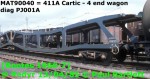
PJA MAT90040 at Radyr, 13th April 1985.
Paul Bartlett
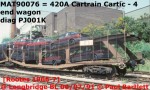
PJA MAT90076 at Longbridge, 6th July 1991.
Paul Bartlett
|
|